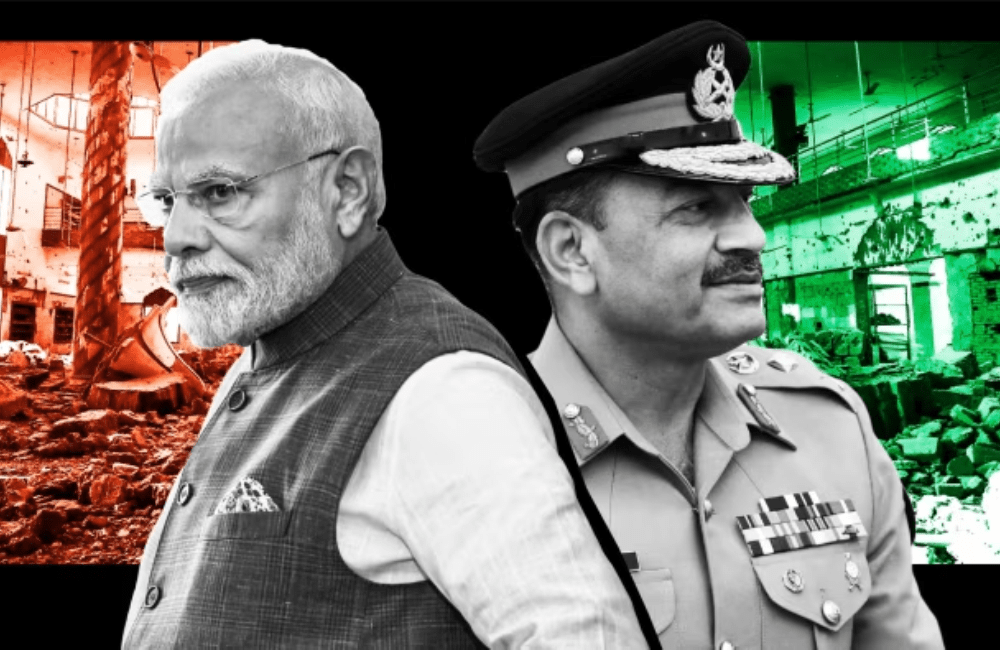
In moments of geopolitical crisis, the public turns to journalism not just for information, but for clarity, context and truth. Yet, during the recent military conflict between India and Pakistan, much of India’s mainstream media chose spectacle over substance.
A recent report in The New York Times by Anupreeta Das and Pragati K.B., with additional reporting by Salman Masood, examines how prominent Indian news outlets became entangled in, and at times helped orchestrate, a wave of disinformation that blurred the line between nationalism and narrative manipulation.
The article paints a troubling picture: Indian television networks reported with breathless urgency on strikes that never occurred, jet fighters that were never downed and even nuclear installations supposedly hit by Indian forces.
These stories were not just shared by anonymous accounts on social media, they were presented as credible news by established anchors, supported by dramatic visuals and maps. Despite their specificity, these reports collapsed under basic scrutiny and have since been debunked. What remained, however, was the damage: to public trust, to responsible journalism and to the already strained regional stability.
While wartime misinformation is not a new phenomenon, the Times’s reporting highlights a disturbing evolution in how falsehoods now enter India’s mainstream media; not through rumor or fringe propaganda but through the very platforms once trusted to uphold journalistic standards.
The authors cite experts like Sumitra Badrinathan and Daniel Silverman, who point out that the problem lies not just in the scale of misinformation, but in its source. When traditional gatekeepers of truth themselves become conduits for deception, the fallout is far more corrosive.
This media moment did not arise in isolation. The Times links the episode to a broader shift in India’s media landscape under Prime Minister Narendra Modi’s leadership, where editorial independence has eroded under political pressure and commercial incentives.
Many large news networks, especially on television, now reflect government talking points rather than scrutinize them. Meanwhile, dissenting voices and independent fact-checkers—such as Alt News, which debunked several viral claims during the conflict—face lawsuits, intimidation and limited reach.
Perhaps the most revealing element of this moment is how quickly false narratives were consumed and recycled by the public. Fueled by historical animosity between India and Pakistan, the appetite for patriotic validation far outpaced the need for verification. Social media provided the accelerant, but it was legacy media that gave the falsehoods their firepower.
As The New York Times notes, terms like “Karachi Port” trended online based on misattributed footage from Gaza; evidence of a digital ecosystem where fiction travels faster than facts, especially when wrapped in the flag.
The rare on-air apology by journalist Rajdeep Sardesai, who admitted to airing unconfirmed reports of Pakistani jets being shot down, was a small act of accountability. Yet it also underscored how far mainstream media had already drifted from its ethical moorings before being compelled to correct course. And corrections, as is often the case, never reach as far or as deep as the original falsehoods.
What this episode illustrates and what the Times report underscores with unflinching clarity, is that the health of a democracy depends not only on the freedom of the press, but also on its integrity. When news organizations abandon the discipline of verification for the immediacy of virality, they risk becoming part of the machinery of propaganda rather than its check. In a region as volatile as South Asia, such a lapse is not just journalistic. it’s geopolitical.
The Times’ article is not an external media’s attack on Indian journalism, but a mirror held up by international observers, reflecting the costs of a media culture that prioritizes narrative over nuance. It’s a call, albeit a stark one, for introspection.
And if Indian media is to recover its role as a pillar of democratic discourse, the reckoning must come not just from the foreign press, but from within the ranks of Indian journalists themselves.

 South Asia Politics