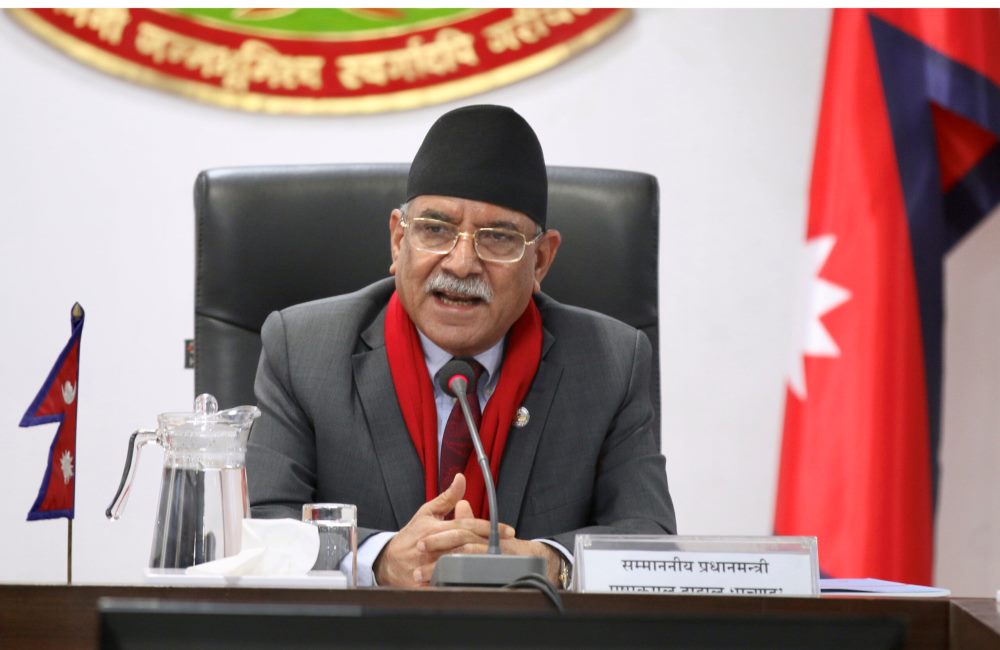
Nepal’s Prime Minister, Pushpa Kamal Dahal, lost a crucial vote of confidence in parliament on July 12, ending his 19-month tenure in office.
The defeat followed the withdrawal of support from the largest party in his governing coalition, the Communist Party of Nepal (Unified Marxist Leninist) (CPN-UML), which had been his main ally. Dahal needed to secure more than half of the votes in the House of Representatives, but he fell short, receiving only 63 votes in his favor compared to 194 votes against him.
The vote loss has forced Dahal to step down, with his government now reduced to caretaker status until a new administration is formed. Nepal’s President, Ram Chandra Poudel, is expected to request political parties to propose a new government once the formal notification of parliament’s decision is made.
Dahal’s government began to unravel after the CPN-UML, led by Khadga Prasad Oli, decided to pull its support. The party entered into a new alliance with the Nepali Congress, the country’s largest political force, and announced that Oli would be the next prime minister.
Despite no major disagreements between Dahal and Oli, the latter was offered the prime ministership by the Nepali Congress, leading to the collapse of Dahal’s administration.
Political analysts have expressed hope that the new alliance could bring stability to the country. Dhruba Adhikary, an independent political analyst, noted that the formation of a government by Nepal’s two largest parties could usher in a period of much-needed political stability.
However, Adhikary also cautioned that given Nepal’s history of frequent government changes, the durability of this new partnership remains uncertain.
Dahal’s government had been fragile from the outset, with constant internal disagreements among coalition members. After becoming prime minister in December 2022 following an inconclusive election, Dahal formed a new alliance to take power. Over the course of his tenure, he was forced to seek a vote of confidence in parliament multiple times, underscoring the instability of his coalition.
This marks Dahal’s third stint as Nepal’s prime minister. Known as Prachanda, or “the fierce one,” Dahal rose to prominence as the leader of the Maoist insurgency that ravaged Nepal from 1996 to 2006, a conflict that claimed over 17,000 lives.
After the insurgency ended, he entered mainstream politics, and his party became the largest parliamentary force in 2008, bringing him to the prime minister’s office. However, his first term was short-lived, as he resigned in 2009 due to differences with the president.
With the collapse of Dahal’s government, the country now faces another chapter of political uncertainty, as the new alliance prepares to take charge.



 South Asia Politics